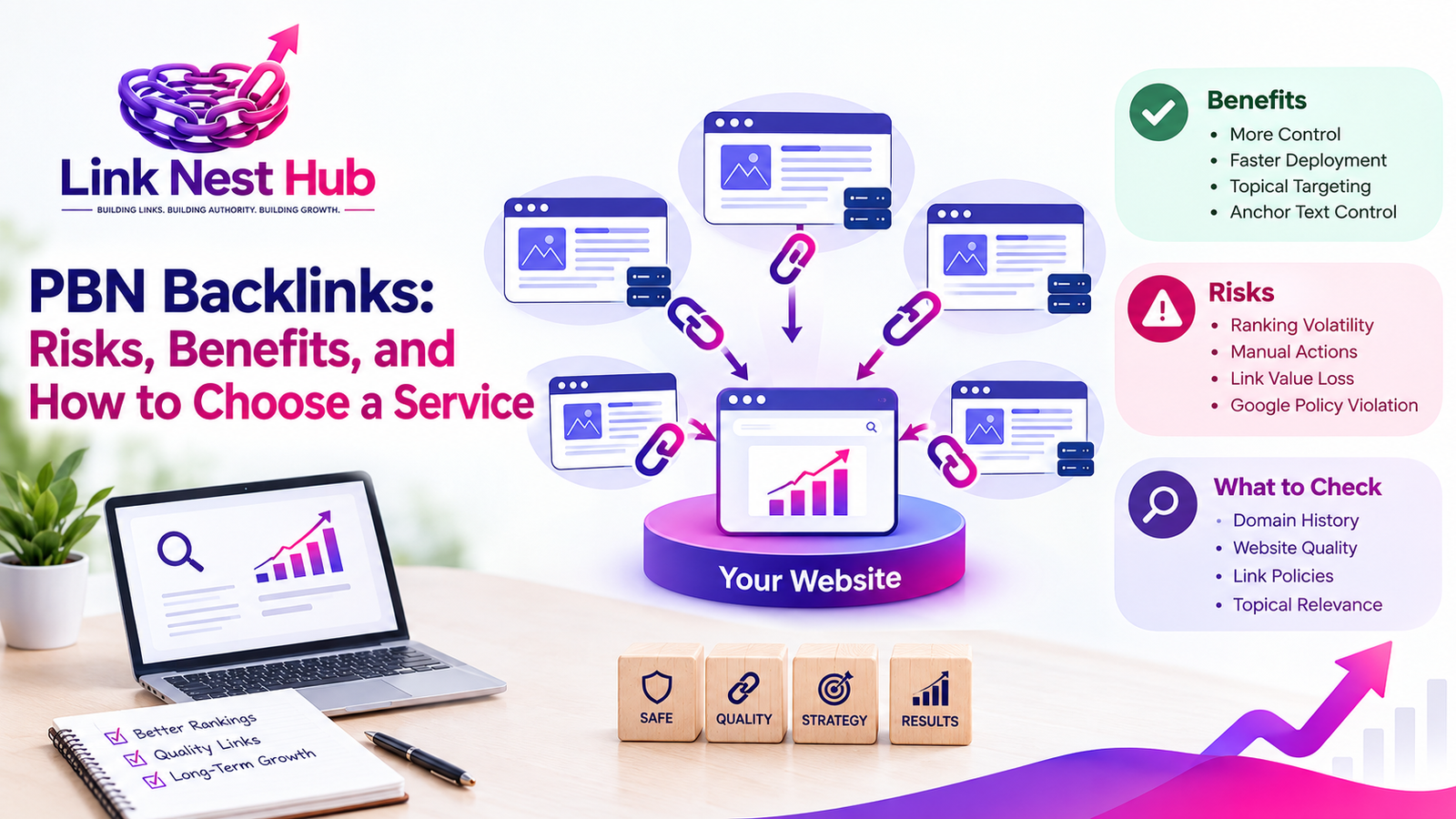
A PBN backlinks service provides backlinks from websites controlled within a private blog network. These links are often marketed as a way to strengthen a website’s backlink profile and support SEO campaigns.
However, PBNs come with important risks. Google states that creating links mainly to manipulate search rankings can fall under its link spam policies. That includes buying or selling links for ranking purposes and creating low-value content mainly to manipulate ranking signals.
So, should you use PBN backlinks? The answer depends on your risk tolerance, SEO goals, and how the links are acquired and used. This guide explains how PBNs work, what to check before buying them, common mistakes, and how to choose a more responsible link-building provider.
What Are PBN Backlinks?
PBN backlinks are links from websites that belong to a Private Blog Network (PBN). A network usually consists of multiple domains managed by the same person, company, or SEO provider.
The basic idea is simple:
- A network contains several websites.
- Those websites publish content.
- Content includes links to target websites.
- The links are intended to influence the target site’s authority or rankings.
PBN providers may use established or expired domains with existing backlinks and historical authority.
However, domain metrics alone do not prove that a website is valuable. A domain can have impressive third-party metrics while having poor content quality, irrelevant links, or a questionable history.
How Does a PBN Backlinks Service Work?
A typical service may involve several stages.
1. Domain Selection
The provider identifies domains that appear to have useful backlink profiles, history, or topical relevance.
2. Website Development
The domain is developed into a functioning website rather than being used as a simple page filled with links.
Quality can vary greatly between providers. Some networks contain useful editorial content, while others rely on thin or repetitive pages.
3. Content Creation
Articles are published on network websites. A target page may receive a contextual link within the article.
4. Link Placement
The provider selects an anchor text and destination URL. The placement may be designed to appear editorial and relevant.
5. Monitoring
Some providers monitor domains, indexing, content, and link status over time.
The problem is that sophisticated-looking implementation does not automatically make a PBN compliant with Google’s policies. Google’s guidance focuses on the purpose and nature of the links, not simply how professional the websites appear.
Are PBN Backlinks Safe for SEO?
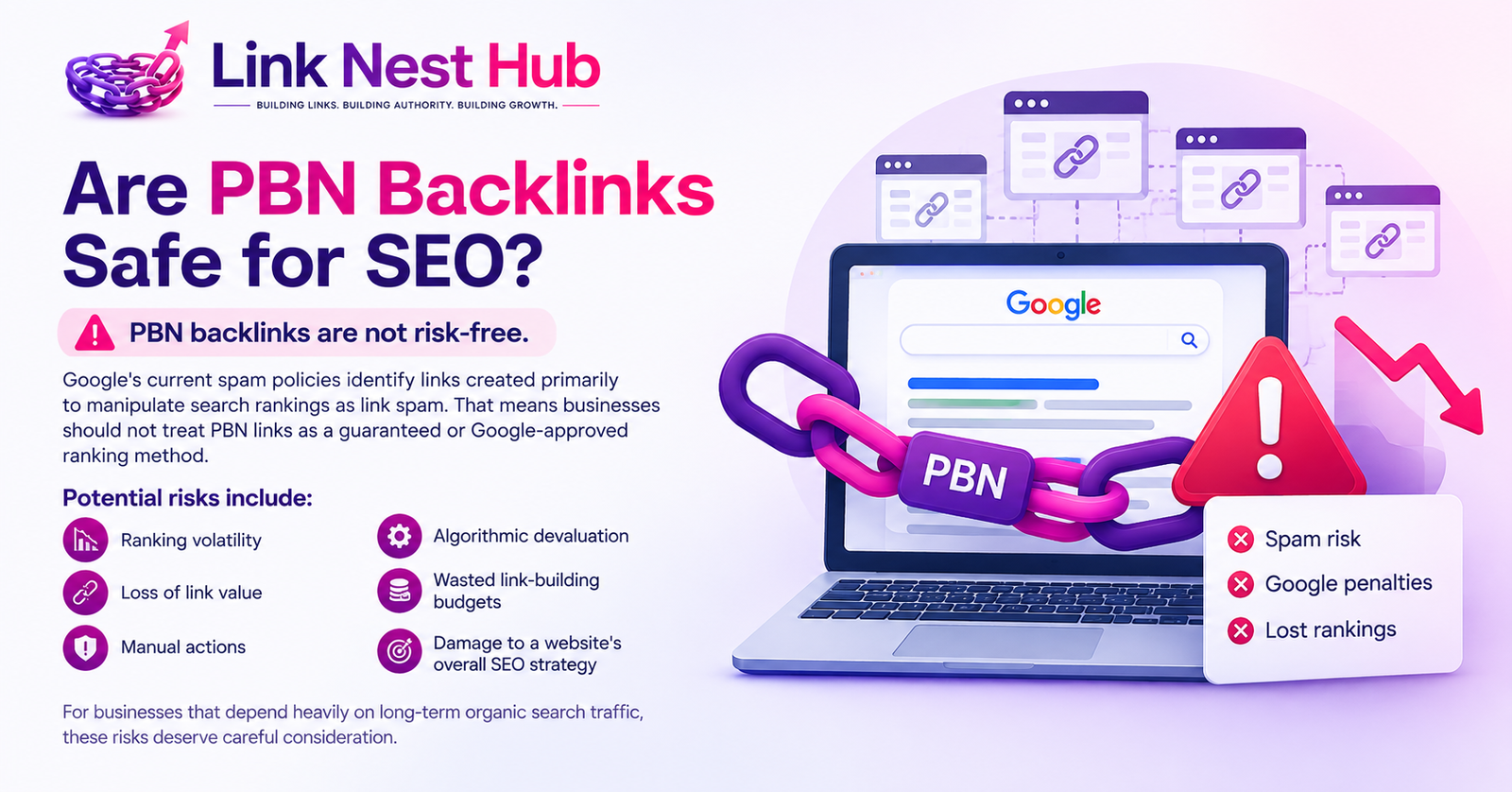
PBN backlinks are not risk-free.
Google’s current spam policies identify links created primarily to manipulate search rankings as link spam. Examples include buying or selling links for ranking purposes, excessive link exchanges, automated link creation, and low-quality content created mainly to manipulate ranking signals.
That means businesses should not treat PBN links as a guaranteed or Google-approved ranking method.
Potential risks include:
- Ranking volatility
- Loss of link value
- Manual actions
- Algorithmic devaluation
- Wasted link-building budgets
- Damage to a website’s overall SEO strategy
For businesses that depend heavily on long-term organic search traffic, these risks deserve careful consideration.
Potential Benefits of PBN Backlinks
Despite the risks, PBN backlinks remain popular in some SEO circles because they offer a high level of control.
Greater Control Over Link Placement
Unlike traditional outreach, a network owner can control where a link appears, what page receives it, and what content surrounds it.
Faster Deployment
A managed network can sometimes place links faster than traditional digital PR or outreach campaigns.
Topical Targeting
Some providers organize networks around specific industries. This can make it easier to find pages that are contextually related to a target website.
Anchor Text Control
The provider may have greater control over the anchor text used for a backlink.
However, control is not the same as SEO value. An unnatural anchor profile or excessive use of optimized anchors can create additional risk.
PBN Backlinks vs. Traditional Link Building
| Factor | PBN Backlinks | Traditional Link Building |
|---|---|---|
| Website control | High | Usually low |
| Placement control | High | Moderate |
| Outreach required | Usually low | Often high |
| Speed | Often faster | Can be slower |
| Cost | Varies | Varies |
| Google policy risk | Higher when used for ranking manipulation | Depends on method |
| Relationship building | Limited | Stronger |
| Long-term brand value | Variable | Often higher |
Traditional link building can include digital PR, editorial outreach, expert contributions, useful resources, partnerships, and genuine editorial mentions.
For long-term SEO, these methods can provide benefits beyond the backlink itself.
What to Look for in a PBN Backlinks Service
If you are evaluating a provider, do not judge the service only by domain authority or another single metric.
Look at the complete link environment.
Check Domain History
Ask whether the provider checks:
- Previous website topics
- Domain history
- Existing backlink profile
- Indexing status
- Spam signals
- Previous ownership or usage
- Topical relevance
A previously abused domain can create problems even when its current metrics look attractive.
Review Website Quality
Look at the actual websites.
Check whether they have:
- Original content
- Clear navigation
- Relevant topics
- Useful pages
- Consistent publishing
- Natural site structure
- Real editorial value
Avoid networks filled with generic articles, unrelated niches, copied material, and obvious link pages.
Ask About Link Policies
A reputable provider should explain how links are placed.
Ask:
- Where will my link appear?
- Is the content original?
- How is anchor text selected?
- Are links permanent?
- What happens if a domain is removed?
- Are replacement links offered?
- Can I review placements?
Clear answers are better than vague promises about rankings.
Common PBN Mistakes to Avoid
Buying Links Based Only on DA or DR
Third-party metrics can be useful for research, but they should not be the only decision factor.
Using Exact-Match Anchors Everywhere
Repeating the same commercial keyword can create an unnatural backlink profile.
Ignoring Topical Relevance
A backlink from an unrelated website may be less useful than a relevant editorial mention.
Building Too Many Links Too Quickly
Large changes in backlink activity can make an SEO campaign look unnatural.
Believing Ranking Guarantees
No legitimate SEO provider can guarantee a specific Google ranking.
Ignoring Google’s Policies
This is the biggest mistake. Google’s spam policies explicitly address links created primarily to manipulate search rankings.
How Link Nest Hub Can Help
Link Nest Hub provides SEO and link-building solutions for businesses, agencies, and website owners that need help managing their off-page SEO campaigns.
If you are considering a PBN backlinks service, the focus should be on transparency and informed decision-making rather than unrealistic ranking promises.
Before ordering, discuss your:
- Target pages
- Industry
- Geographic market
- Anchor text preferences
- Existing backlink profile
- SEO goals
- Risk tolerance
- Campaign budget
A good campaign should fit your wider SEO strategy instead of relying on one backlink type.
PBN Backlinks: Best Practices
If you decide to explore PBN links, use a careful evaluation process.
- Audit your existing backlink profile first.
- Review every proposed domain rather than relying on metrics.
- Prioritize topical relevance.
- Avoid obviously low-quality websites.
- Keep anchor text natural and varied.
- Do not expect guaranteed rankings.
- Diversify your overall SEO strategy.
- Understand the risks before investing.
- Monitor your rankings and backlink profile.
- Use editorial and brand-focused link acquisition alongside other strategies.
Remember that paid links used for advertising can be qualified with nofollow or sponsored attributes. Google’s documentation specifically recognizes these attributes for links that should not pass ranking credit.
Internal Linking Opportunities
Consider adding these internal links naturally within the article:
- SEO Link Building Services → Link to your main link-building services page.
- Guest Post Services → Link to your guest posting service page.
- Link Insertion Services → Link to your link insertion service.
- PBN Web Design → Link to your PBN website development service.
- GD Web Development → Link to your web development service.
Authoritative External Sources
For stronger E-E-A-T, consider linking to these official Google resources:
Google’s site reputation policy has also been updated recently, reinforcing the importance of avoiding tactics designed primarily to exploit established ranking signals.
FAQs
What are PBN backlinks?
PBN backlinks are links from websites within a private blog network. The websites are generally controlled by the same owner or SEO provider.
Are PBN backlinks good for SEO?
They can provide link placement and control, but they also carry SEO risk when created primarily to manipulate rankings. Google classifies manipulative link practices as link spam.
Is buying PBN backlinks against Google guidelines?
Buying links for the purpose of manipulating rankings can violate Google’s link spam policies. Paid advertising links should be properly qualified when they are not intended to pass ranking credit.
How much does a PBN backlinks service cost?
Pricing varies by provider, domain quality, niche, content requirements, and placement. A low price does not necessarily mean good value.
What makes a PBN backlink valuable?
Relevant content, a credible domain history, a healthy backlink profile, and genuine website quality are more useful considerations than relying on one domain metric.
Can PBN backlinks guarantee Google rankings?
No. SEO rankings depend on many factors, and no responsible provider can guarantee a specific Google position.
Should small businesses use PBN backlinks?
Small businesses should consider their risk tolerance and dependence on organic search traffic before using PBNs. Safer long-term strategies may include digital PR, useful content, genuine outreach, and editorial link acquisition.
What is the difference between PBN backlinks and guest posts?
A PBN involves websites controlled within a private network. Guest posting normally involves contributing content to an independently operated publication or website. The SEO value and policy implications depend on how the links are created and used.
Are high-DA PBN backlinks always better?
No. Domain authority is a third-party metric, not a Google ranking score. Website relevance, quality, history, and backlink profile should also be evaluated.
How should I choose a PBN backlinks service?
Review the provider’s domains, content quality, link placement process, transparency, pricing, replacement policy, and approach to anchor text. Avoid providers making guaranteed ranking claims.
Conclusion
A PBN backlinks service can offer control over website placement, content, and anchor text, but it also carries meaningful SEO risks. Google specifically warns against links created primarily to manipulate search rankings.
For that reason, PBN backlinks should never be viewed as a guaranteed shortcut to higher rankings. Evaluate the domains, content, relevance, link profile, and provider carefully before making a decision.
If you want to explore link building with Link Nest Hub, start by discussing your website, niche, target pages, and SEO goals. A broader strategy that combines quality content, relevant mentions, outreach, and carefully evaluated link opportunities can provide a more sustainable foundation for organic growth.